

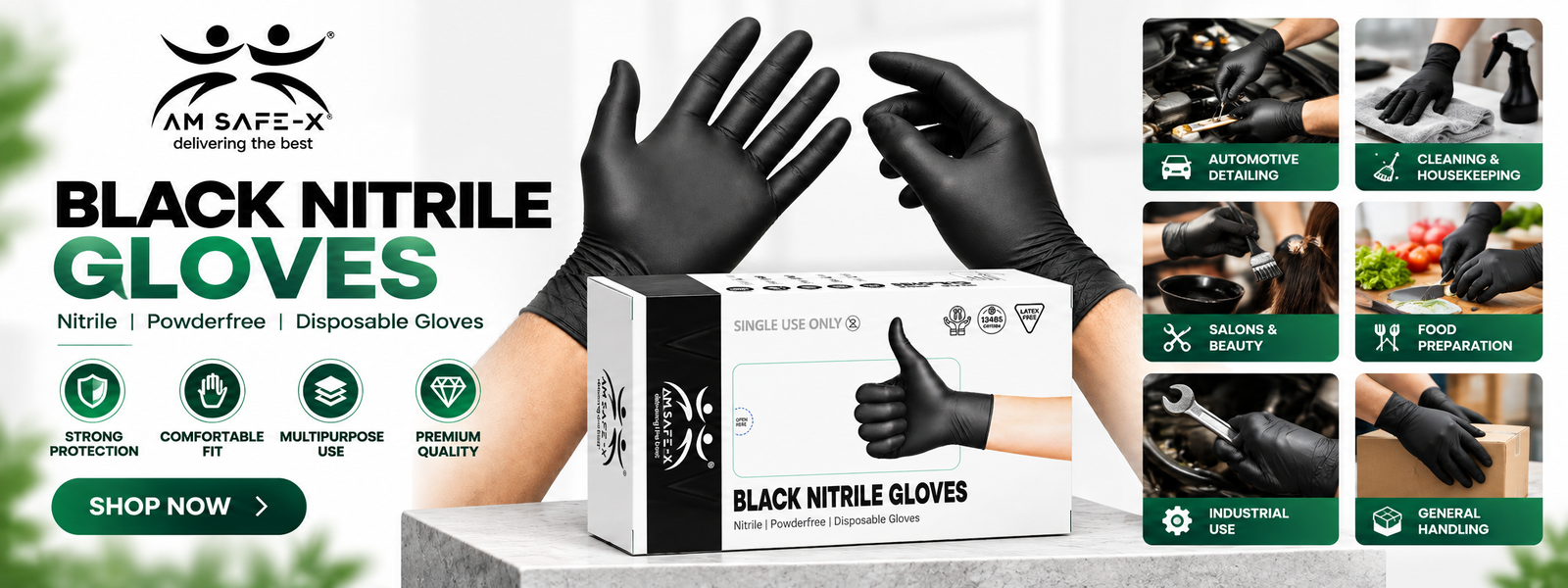
Choosing the best nitrile gloves in India is not just about finding the lowest price. Whether you work in automotive detailing, cleaning, beauty services, food preparation, manufacturing or general professional handling, choosing suitable gloves can make a significant difference in comfort, grip and everyday performance.
With numerous disposable gloves available online, buyers often have questions: Are nitrile gloves better than latex or vinyl? What thickness should you choose? Are black nitrile gloves better than blue ones? How can you identify good-quality gloves? And what should you consider before purchasing nitrile gloves in bulk?
This comprehensive buying guide from AM SAFE-X explains nitrile glove materials, sizes, thickness, applications, prices and buying considerations to help you make an informed decision.
Quick Answer: Which Are the Best Nitrile Gloves in India?
The best nitrile gloves are those that fit comfortably, offer suitable durability for the intended task and provide reliable quality at a reasonable price.
For general-purpose applications, powder-free nitrile gloves are a popular option because they are made from synthetic rubber, contain no natural rubber latex proteins and generally offer better puncture resistance than many disposable vinyl alternatives.
Our recommendations by application:
Automotive detailing: Black nitrile gloves with comfortable fit and suitable grip.
Cleaning and housekeeping: Powder-free nitrile gloves appropriate for the cleaning products being used.
Salons and beauty services: Flexible nitrile gloves that allow comfortable finger movement.
Food preparation: Gloves with verified suitability for the intended food-contact application.
Industrial handling: Nitrile gloves with appropriate thickness and documented performance for the task.
Everyday professional use: Comfortable, powder-free disposable nitrile gloves available in suitable sizes.
For buyers looking for black, powder-free, latex-free disposable gloves, AM SAFE-X Black Nitrile Gloves – Pack of 100 are an option worth exploring.
1. What Are Nitrile Gloves?
Nitrile gloves are disposable gloves manufactured from synthetic nitrile rubber, commonly known as nitrile butadiene rubber (NBR).
Unlike natural rubber latex gloves, nitrile gloves are manufactured using synthetic materials rather than natural rubber latex.
Nitrile gloves are widely used for general-purpose handling because they offer a useful combination of flexibility, grip, comfort and resistance to certain substances.
Key Features of Nitrile Gloves
1. Synthetic rubber material
Nitrile is manufactured from synthetic polymers, making it an alternative to natural rubber latex gloves.
2. Puncture resistance
Nitrile gloves often provide better puncture resistance than disposable vinyl gloves, although performance varies by thickness, formulation and manufacturing quality.
3. Comfortable fit
Well-designed nitrile gloves conform to the shape of the hand and allow comfortable finger movement.
4. Powder-free options
Powder-free nitrile gloves help avoid loose powder residue during everyday handling tasks.
5. Resistance to certain oils and greases
Nitrile can provide resistance to selected oils, greases and chemicals, depending on the specific glove and substance.
6. Multiple colours and sizes
Nitrile gloves are available in black, blue and other colours, with different sizes and thicknesses to suit different needs.
2. Why Are Nitrile Gloves Popular in India?
Nitrile gloves are widely used in various Indian businesses because they offer practical advantages for routine handling, cleaning and professional work.
Convenient for everyday tasks
Disposable nitrile gloves can help reduce direct hand contact with dirt and selected materials when used correctly.
Comfortable for professional work
Their flexibility can make them suitable for tasks requiring regular hand movement.
Available in different colours
Black and blue nitrile gloves allow businesses to select gloves based on their working environment and preferences.
Practical packaging
Packs of 100 gloves are convenient for businesses and individuals who regularly use disposable gloves.
Suitable for various industries
Nitrile gloves are commonly selected for automotive detailing, salons, housekeeping, maintenance and general-purpose handling.
Actual suitability depends on the product’s specifications and intended-use instructions.
3. Nitrile vs Latex vs Vinyl Gloves: Complete Comparison
One of the most common questions buyers ask is whether nitrile gloves are better than latex or vinyl gloves.
The answer depends on the intended application.
| Feature | Nitrile Gloves | Latex Gloves | Vinyl Gloves |
|---|---|---|---|
| Material | Synthetic nitrile rubber | Natural rubber latex | Polyvinyl chloride |
| Natural latex proteins | Absent | Present | Absent |
| Fit | Generally close-fitting | Highly elastic | Often looser |
| Flexibility | Good | Excellent | Varies |
| Puncture resistance | Often good | Often good | Generally lower |
| Resistance to oils | Product-dependent | Product-dependent | Product-dependent |
| Typical applications | Cleaning, detailing, general handling | General handling where latex is appropriate | Selected low-risk tasks |
| Price | Varies | Varies | Often economical |
Why choose nitrile gloves?
Nitrile gloves are often preferred by buyers looking for latex-free disposable gloves with a comfortable fit and suitable handling performance.
When might latex gloves be suitable?
Latex gloves offer excellent elasticity but contain natural rubber latex proteins, which can cause allergic reactions in some people.
When might vinyl gloves be suitable?
Vinyl gloves may be an economical option for selected low-risk, short-duration tasks.
Buying tip: Always compare the exact product specifications rather than assuming that every glove made from the same material performs identically.
4. Black Nitrile Gloves vs Blue Nitrile Gloves: Which Should You Choose?
Black and blue nitrile gloves are both manufactured using nitrile-based materials.
Their main visible difference is colour, although individual products may also differ in thickness, texture, formulation and durability.
Black nitrile gloves
Black nitrile gloves are commonly selected for:
Automotive detailing
Car washing and maintenance
Barber shops
Hair salons
Tattoo and beauty studios
Cleaning services
Workshop handling
General maintenance
Black gloves offer a professional appearance and can make certain stains, such as grease and ink, less noticeable.
However, this also means some contamination may be harder to see.
Blue nitrile gloves
Blue nitrile gloves are often selected for:
General cleaning
Food preparation, where the product is approved for the intended use
Housekeeping
Packaging
Routine handling
Manufacturing operations
Are black nitrile gloves stronger than blue nitrile gloves?
Not necessarily.
Glove colour does not determine durability, puncture resistance or quality.
The actual performance depends on the glove’s thickness, formulation, construction and testing.
AM SAFE-X offers black and blue nitrile gloves for buyers seeking different colour options.
5. How to Choose the Right Nitrile Glove Thickness
Glove thickness is an important factor when comparing disposable nitrile gloves.
Thickness is commonly measured in mils.
One mil equals approximately 0.0254 millimetres.
| Thickness | Approximate measurement | General consideration |
|---|---|---|
| 3 mil | 0.076 mm | Thin disposable gloves emphasizing dexterity |
| 4 mil | 0.102 mm | Common general-purpose category |
| 5 mil | 0.127 mm | More substantial disposable glove |
| 6 mil | 0.152 mm | Thicker option for selected handling tasks |
| 8 mil | 0.203 mm | Heavy-duty disposable category |
These are general thickness categories, not guaranteed performance ratings.
Are thicker nitrile gloves always better?
No.
Thicker gloves may provide a more substantial physical barrier, but they can also reduce tactile sensitivity.
Performance depends on material quality, manufacturing processes and the task being performed.
What should buyers check?
Before purchasing, check whether thickness is measured at the fingertips, palm or cuff.
These measurements can differ.
For tasks involving chemical exposure, consult product-specific compatibility data instead of relying only on thickness.
6. How to Choose the Correct Nitrile Glove Size
Correct sizing is essential for comfort and ease of movement.
Gloves that are too tight can restrict finger movement, while oversized gloves can reduce grip and control.
How to measure your hand
Take a flexible measuring tape.
Measure around the widest part of your palm, excluding your thumb.
Keep your hand relaxed.
Compare the measurement with the manufacturer’s sizing chart.
Select the size that provides a comfortable, secure fit.
Signs your gloves are too small
Tightness around the knuckles
Difficulty moving your fingers
Excessive stretching
Discomfort during extended use
Increased likelihood of tearing while putting them on
Signs your gloves are too large
Loose fingertips
Gloves slipping during use
Excess material around the palm
Reduced precision when handling small objects
Which size should you buy?
Always follow the size chart for the specific glove model.
Size labels such as small, medium and large may vary between manufacturers.
7. Powder-Free vs Powdered Nitrile Gloves
Disposable gloves are available in different formulations, including powder-free options.
What are powder-free nitrile gloves?
Powder-free nitrile gloves are manufactured without added donning powder.
They are commonly preferred in environments where loose powder residue is undesirable.
Benefits of powder-free nitrile gloves
Cleaner handling
Powder-free gloves help avoid transferring loose glove powder onto surfaces.
Reduced powder residue
They can be useful for tasks where maintaining a clean working environment matters.
Convenient everyday use
Powder-free nitrile gloves are widely available for general-purpose applications.
Are powder-free gloves allergy-free?
Not necessarily.
Although nitrile gloves do not contain natural rubber latex proteins, some users may react to other ingredients used in manufacturing.
Buyers with known sensitivities should review the product formulation.
Explore: AM SAFE-X Black Powder-Free Nitrile Gloves – Pack of 100
8. Best Nitrile Gloves for Different Industries in India
Different industries have different handling requirements.
A. Nitrile Gloves for Automotive Detailing
Automotive detailing professionals regularly handle dirt, oils, polishing materials and cleaning products.
Black nitrile gloves are popular in this industry because of their appearance and practical handling characteristics.
What to look for:
Comfortable fit
Suitable grip
Appropriate thickness
Powder-free construction
Verified compatibility with the substances being handled
Disposable nitrile gloves should not be assumed to protect against all automotive solvents, fuels or degreasers.
B. Nitrile Gloves for Salons and Beauty Professionals
Salon professionals often need gloves for tasks involving hair colour, cosmetic products and cleaning materials.
What to look for:
Comfortable finger movement
Appropriate sizing
Powder-free design
Suitable grip
Compatibility with the products being handled
Black nitrile gloves are frequently chosen for their professional appearance.
C. Nitrile Gloves for Tattoo and Beauty Studios
Tattoo and beauty professionals may prefer close-fitting gloves that allow precise finger movement.
However, tasks involving potential exposure to blood or bodily fluids require task-appropriate protective equipment and documented performance.
General-purpose disposable gloves should not be assumed suitable for those procedures.
D. Nitrile Gloves for Food Preparation
Disposable gloves are used in many food-handling environments.
However, food-contact suitability must be verified for the specific glove.
What to look for:
Documented suitability for intended food contact
Appropriate sizing
Clean packaging
Powder-free construction where appropriate
Clear usage instructions
Gloves do not replace handwashing or proper food hygiene practices.
E. Nitrile Gloves for Cleaning and Housekeeping
Cleaning teams may use disposable gloves while handling dirt, cleaning solutions and household materials.
What to look for:
Appropriate fit
Comfortable handling
Suitable thickness
Compatibility with the cleaning products used
Reliable packaging
For concentrated chemicals or prolonged exposure, reusable chemical-resistant gloves may be more suitable than thin disposable gloves.
F. Nitrile Gloves for Workshops and General Maintenance
Workshop personnel may use nitrile gloves for routine handling, light maintenance and selected cleaning tasks.
What to look for:
Good grip
Comfortable fit
Appropriate durability
Suitable thickness
Product-specific chemical resistance information where necessary
Disposable nitrile gloves should not be worn around rotating machinery when there is a risk of entanglement.
9. How to Identify Good-Quality Nitrile Gloves
When purchasing nitrile gloves, quality should be evaluated using more than packaging design or promotional claims.
Material quality
Confirm that the product is manufactured from nitrile and that its formulation suits the intended application.
Thickness consistency
Review the manufacturer’s thickness specifications and measurement methods.
Comfortable fit
Choose gloves that fit securely without restricting normal finger movement.
Resistance to tearing
A glove should withstand normal handling appropriate to its intended use.
However, no disposable glove is tear-proof.
Packaging quality
Check that the packaging is intact and includes relevant product information.
Manufacturing and batch information
Where available, review batch details, manufacturing information, storage instructions and product documentation.
Reliable supplier information
Choose suppliers who provide clear specifications and accurate product descriptions.
10. What Does AQL Mean in Nitrile Gloves?
AQL stands for Acceptable Quality Limit.
It is used in quality-control sampling processes to assess whether a manufacturing lot meets defined acceptance criteria.
In disposable glove manufacturing, AQL may be used in testing for defects such as pinholes.
Does a lower AQL mean better quality?
A lower AQL generally represents a stricter acceptance criterion under the applicable sampling plan.
However, AQL does not guarantee that every individual glove is free from defects.
What should buyers check?
Whether the manufacturer provides relevant quality-control information
Which testing method was used
Whether the reported AQL applies to the actual product
Whether supporting documentation is available
Do not assume an AQL value unless the manufacturer has verified it.
11. Are Nitrile Gloves Resistant to Oils, Grease and Cleaning Chemicals?
Nitrile gloves can provide resistance to certain oils, greases and chemicals.
However, resistance varies by product formulation, thickness, exposure duration and the specific substance involved.
Important factors affecting performance
Type of chemical or substance
Concentration
Temperature
Duration of contact
Glove thickness
Manufacturing quality
Mechanical stress during use
Can nitrile gloves be used with cleaning chemicals?
Some nitrile gloves may be suitable for certain cleaning products, but compatibility must be verified.
For concentrated chemicals, solvents or extended exposure, consult the manufacturer’s compatibility information and the chemical’s Safety Data Sheet.
Never assume that all nitrile gloves provide the same level of protection.
12. How to Compare the Best Nitrile Gloves in India
Before buying, compare these seven factors.
1. Intended use
Choose gloves based on the actual task.
2. Material
Confirm that the gloves are nitrile and review the formulation information.
3. Thickness
Compare the specified thickness and whether it suits your handling requirements.
4. Size
Choose a secure, comfortable fit.
5. Texture and grip
Text

