

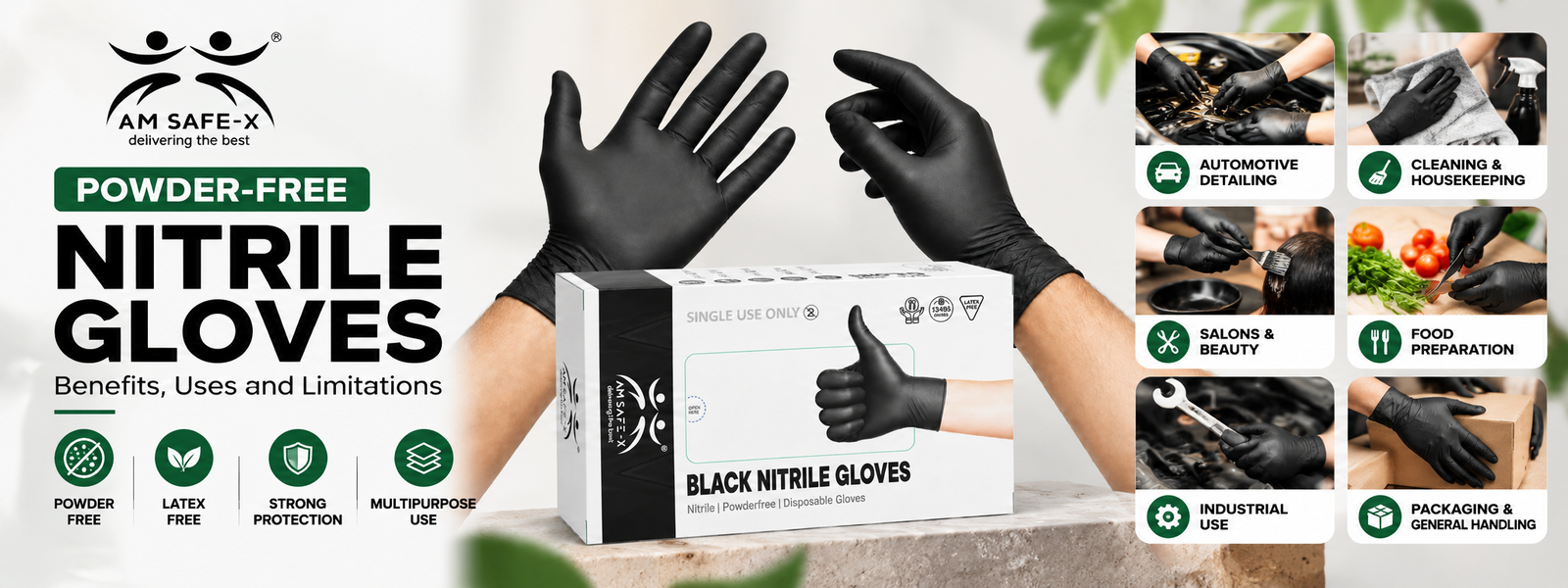
Powder-free nitrile gloves are among the most practical disposable glove options for cleaning, automotive detailing, salons, workshops, packaging and everyday professional handling. Made from synthetic nitrile rubber without added donning powder, these gloves offer a useful combination of flexibility, comfort and resistance to certain everyday substances.
But what exactly makes powder-free nitrile gloves different from powdered gloves? Are they better than latex or vinyl? Can they be used for cleaning chemicals, automotive work or food handling? And what are their limitations?
If you’re searching for powder-free nitrile gloves in India, understanding these differences can help you choose a product that suits your work rather than purchasing based on appearance or price alone.
In this complete guide, AM SAFE-X explains how powder-free nitrile gloves work, their main advantages, common applications, limitations, sizing considerations and important factors to check before buying.
Quick Answer: What Are Powder-Free Nitrile Gloves?
Powder-free nitrile gloves are disposable gloves manufactured from synthetic nitrile rubber without added donning powder.
They are commonly selected for general-purpose tasks where users want comfortable hand movement, minimal powder residue and a disposable barrier appropriate to the work.
Key Benefits
No added donning powder
No natural rubber latex proteins
Flexible, close-fitting material
Generally good puncture resistance compared with many disposable vinyl gloves
Available in multiple sizes and colours
Useful for selected cleaning, detailing, salon and general handling applications
Convenient single-use format
Important Limitations
Not resistant to every chemical
Can tear, puncture or degrade
Not automatically suitable for food contact
Not designed for protection against heat, cuts or sharp tools
Can cause skin sensitivities in some individuals
Usually intended for single use
May be unsuitable around rotating machinery
Bottom line: Powder-free nitrile gloves can be an excellent general-purpose option when their specifications match the task, but they are not universal protective gloves.
For buyers looking for black, powder-free, latex-free disposable gloves, explore AM SAFE-X Black Nitrile Gloves – Pack of 100.
1. What Are Powder-Free Nitrile Gloves?
Powder-free nitrile gloves are disposable hand coverings manufactured primarily from nitrile butadiene rubber (NBR), a synthetic rubber material.
Unlike traditional powdered disposable gloves, powder-free versions are manufactured without added donning powder.
Donning powder was historically used in certain disposable gloves to make them easier to put on and remove. However, powder can transfer to surfaces, handled objects and work materials.
Powder-free glove manufacturing uses processes designed to provide suitable donning characteristics without relying on added loose powder.
What Is Nitrile Rubber?
Nitrile rubber is a synthetic material commonly produced using acrylonitrile and butadiene.
Its properties make it useful in products requiring flexibility and resistance to selected oils and other substances.
In disposable gloves, nitrile is processed into a thin, flexible material that can conform to the hand.
The exact performance of a nitrile glove depends on its formulation, thickness, manufacturing process and quality control.
What Does Powder-Free Mean?
The term powder-free indicates that the glove is manufactured without added donning powder.
It does not mean that the glove is free from every chemical residue, allergen or potential contaminant.
Similarly, powder-free does not automatically mean that a glove is suitable for every application.
2. Why Are Powder-Free Nitrile Gloves Popular in India?
Businesses across India use disposable gloves for many different handling activities.
From car detailing studios and cleaning services to salons, packaging operations and maintenance teams, there is demand for gloves that are practical, comfortable and easy to replace.
Reduced Powder Transfer
One of the most important advantages of powder-free gloves is that they avoid loose donning powder transferring onto work surfaces.
This can be useful when handling materials where powder residue is undesirable.
Comfortable Everyday Handling
Properly sized nitrile gloves can allow users to grip tools, handle products and perform routine tasks without excessive restriction.
Convenient for Repetitive Work
Disposable gloves can be changed between tasks or when contaminated.
For businesses using gloves regularly, packs of 100 offer a convenient purchasing format.
Different Colours for Different Preferences
Powder-free nitrile gloves are available in black, blue and other colours.
Black is frequently preferred for automotive detailing and salons, while blue is often chosen for visibility or workplace colour identification.
However, colour alone does not determine glove performance.
Options for Different Budgets
Indian buyers can compare disposable nitrile gloves based on price per glove, thickness, fit, packaging quantity and verified product specifications.
3. Top 10 Benefits of Powder-Free Nitrile Gloves
Understanding the benefits helps buyers determine whether powder-free nitrile gloves are suitable for their requirements.
Benefit 1: No Added Donning Powder
Powder-free gloves eliminate the use of added donning powder.
This helps reduce loose powder residue during routine handling.
For businesses concerned about keeping work surfaces free from glove powder, this is an important consideration.
Benefit 2: Latex-Free Material
Nitrile gloves are made from synthetic rubber rather than natural rubber latex.
They therefore do not contain natural rubber latex proteins as part of their base material.
This makes nitrile an alternative for people seeking to avoid natural rubber latex exposure.
However, some people can still experience reactions to other glove ingredients.
Benefit 3: Flexible and Comfortable Fit
A properly sized nitrile glove can fit closely around the hand.
This may help users perform tasks requiring finger movement, including packaging, cleaning and selected detailing activities.
Comfort depends on glove size, formulation, thickness and duration of use.
Benefit 4: Generally Good Puncture Resistance
Nitrile gloves often provide better puncture resistance than many disposable vinyl alternatives.
However, no thin disposable glove is puncture-proof.
Actual performance depends on the specific product and the conditions of use.
Benefit 5: Resistance to Selected Oils and Greases
Certain nitrile formulations can resist oils and greases encountered during routine work.
This is one reason nitrile gloves are popular in automotive and maintenance environments.
However, chemical compatibility must be checked for the exact substance.
Benefit 6: Available in Different Thicknesses
Powder-free nitrile gloves are available in multiple thickness categories.
Thinner gloves may provide greater tactile sensitivity, while thicker options may feel more substantial.
Neither thickness nor appearance alone guarantees performance.
Benefit 7: Available in Different Colours
Black and blue nitrile gloves allow users to select a colour according to workplace preferences.
Black gloves are often chosen for appearance, while blue gloves can offer visual contrast.
Benefit 8: Convenient Disposable Design
Single-use gloves are designed to be replaced rather than repeatedly cleaned and reused.
This can be convenient when work requires frequent glove changes.
Benefit 9: Useful for Multiple General-Purpose Applications
Depending on their specifications, powder-free nitrile gloves can be useful for selected cleaning, automotive detailing, salon, packaging and routine handling tasks.
Benefit 10: Easy to Purchase in Bulk
Packs of 100 gloves allow businesses to estimate consumption, compare unit prices and manage regular purchasing.
Important: These are general characteristics of powder-free nitrile gloves. Individual products must be evaluated against their actual specifications.
4. Powder-Free vs Powdered Gloves: What’s the Difference?
The primary difference is whether added donning powder is used.
| Feature | Powder-Free Nitrile Gloves | Powdered Disposable Gloves |
|---|---|---|
| Added donning powder | No | Yes |
| Loose powder transfer | Avoids added donning powder | Powder can transfer to surfaces |
| Material options | Nitrile | Depends on product |
| Donning characteristics | Depends on manufacturing treatment | Powder can assist donning |
| Surface residue | Generally preferable where powder residue is undesirable | May leave powder residue |
| Skin compatibility | Individual sensitivities remain possible | Individual sensitivities remain possible |
| Typical purchasing preference | Common for modern general-purpose applications | Depends on application and market |
Are Powder-Free Gloves Always Better?
Not automatically.
Powder-free gloves are often preferred when avoiding powder residue matters, but the best choice still depends on the intended task and product specifications.
A powder-free glove that is too thin, poorly fitted or unsuitable for the chemicals involved may be less appropriate than a different glove selected for the task.
Why Do Many Buyers Prefer Powder-Free Nitrile Gloves?
They combine the convenience of disposable gloves with the ability to avoid added donning powder.
For many routine professional applications, that is a useful practical advantage.
5. Powder-Free Nitrile vs Latex vs Vinyl Gloves
Another common buying question is whether powder-free nitrile gloves are better than latex or vinyl gloves.
Each material has different properties.
| Feature | Nitrile | Latex | Vinyl |
|---|---|---|---|
| Base material | Synthetic nitrile rubber | Natural rubber latex | Polyvinyl chloride |
| Natural rubber latex proteins | Absent | Present | Absent |
| Fit | Generally close-fitting | Generally highly elastic | Often looser |
| Flexibility | Good | Often excellent | Varies |
| Puncture resistance | Often good | Often good | Generally lower |
| Resistance to selected oils | Formulation-dependent | Formulation-dependent | Formulation-dependent |
| Powder-free versions | Available | Available | Available |
| Typical uses | Cleaning, detailing, handling | Suitable tasks where latex is acceptable | Selected low-risk tasks |
When Should You Choose Nitrile?
Consider nitrile when you want a latex-free disposable glove with a close fit and suitable performance for the task.
When Might Latex Be Considered?
Latex gloves can offer excellent elasticity but are unsuitable for individuals with natural rubber latex allergies.
When Might Vinyl Be Considered?
Vinyl gloves can be useful for certain short-duration, low-risk tasks when their performance is sufficient.
Buying advice: Do not compare gloves only by material. Check the specific manufacturer’s instructions and performance information.
6. Best Uses of Powder-Free Nitrile Gloves
Powder-free nitrile gloves are used in a wide range of workplaces, but suitability depends on the exact task.
A. Automotive Detailing and Car Cleaning
Automotive detailers regularly work with dust, dirt, polishing materials, cleaning products and other residues.
Black powder-free nitrile gloves are popular in this environment because of their appearance and handling characteristics.
Potential advantages:
Comfortable finger movement
No added donning powder
Professional black appearance
Convenient disposable format
Resistance to selected substances when verified
Limitations:
Automotive products can contain solvents, fuels, degreasers and other chemicals that may degrade disposable nitrile gloves.
Always check the product-specific compatibility information before use.
Explore: AM SAFE-X Black Nitrile Gloves
B. Cleaning and Housekeeping
Cleaning teams may use disposable gloves for suitable routine tasks involving dirt, dust and certain cleaning materials.
Powder-free gloves help avoid added powder residue on surfaces.
What to check:
Compatibility with cleaning products
Correct size
Appropriate thickness
Suitable cuff length
Comfort during use
For concentrated chemicals or prolonged wet work, reusable chemical-resistant gloves may be more appropriate.
C. Salons and Beauty Services
Salon professionals may use disposable gloves during selected grooming, hair-colour handling and cleaning activities.
Black nitrile gloves are often chosen for their professional appearance.
Potential advantages:
Flexible fit
Powder-free construction
Convenient replacement
Availability in different sizes
Hair dyes and cosmetic chemicals vary in formulation. Always confirm glove compatibility with the products being used.
D. Packaging and Product Handling
Packaging teams may need gloves for selected tasks involving sorting, labeling, packing and handling products.
Powder-free gloves may be useful when avoiding added powder residue is desirable.
For this application, comfortable fit and ease of movement can be especially important.
E. Workshops and General Maintenance
Nitrile gloves may be useful for selected routine maintenance tasks where a disposable barrier is appropriate.
However, thin disposable gloves do not replace cut-resistant, heat-resistant or specialized chemical-protective gloves.
Important: Do not wear disposable gloves around rotating machinery when they could become caught or pulled into moving parts.
F. Food Preparation and Handling
Some powder-free nitrile gloves are manufactured for food-contact applications.
However, powder-free and nitrile do not automatically mean food-contact approved.
Food businesses should use gloves with documented suitability for the intended food-contact conditions.
AM SAFE-X products should not be described as food-contact suitable unless the specific product documentation supports that claim.
Gloves also do not replace handwashing or proper food hygiene procedures.
7. Limitations of Powder-Free Nitrile Gloves
Understanding the limitations is essential before purchasing.
Limitation 1: They Are Not Resistant to Every Chemical
Nitrile can resist certain substances, but compatibility varies significantly.
Some solvents and chemicals can penetrate, degrade or damage nitrile.
Always review manufacturer-specific chemical resistance information.
Limitation 2: They Can Tear or Puncture
Disposable nitrile gloves are thin and flexible.
Sharp edges, excessive stretching, damaged fingernails or abrasive surfaces can cause tearing.
Inspect gloves before use and replace damaged gloves immediately.
Limitation 3: They Do Not Provide Cut Protection
Thin nitrile gloves are not substitutes for gloves specifically designed to resist cuts.
Tasks involving blades, sharp metal or broken glass may require additional or alternative protection.
Limitation 4: They Are Not Heat-Resistant Gloves
Disposable nitrile gloves are not designed to replace heat-resistant gloves.
Do not use them as protection against hot cookware, heated machinery or other high-temperature surfaces.
Limitation 5: They Are Usually Single-Use
Most thin disposable nitrile gloves are intended for one-time use.
Repeated washing or reuse can compromise the glove or transfer contamination.
Limitation 6: Skin Sensitivities Are Still Possible
Although nitrile does not contain natural rubber latex proteins, some individuals may react to chemical accelerators or other ingredients.
People with known sensitivities should check the manufacturer’s formulation information.
Limitation 7: Fit Can Affect Performance
Gloves that are too tight may tear more easily during donning.
Gloves that are too loose can reduce dexterity and grip.
Limitation 8: Not Every Glove Is Suitable for Food Contact
Food-contact suitability must be documented for the specific product.
Limitation 9: They Can Be Unsuitable Around Machinery
Loose or disposable gloves can create entanglement hazards around rotating equipment.
Follow workplace machinery safety procedures.
Limitation 10: Disposal Requires Attention
Used gloves may require different disposal methods depending on what they contacted.
Gloves contaminated with hazardous substances must be disposed of according to applicable requirements.
8. How to Choose the Right Powder-Free Nitrile Glove Thickness
Thickness is one of the most important technical characteristics to consider.
Glove thickness is often expressed in mils.
One mil equals approximately 0.0254 millimetres.
| Thickness | Approximate measurement | General consideration |
|---|---|---|
| 3 mil | 0.076 mm | Thin, dexterity-oriented disposable glove |
| 4 mil | 0.102 mm | Common general-purpose category |
| 5 mil | 0.127 mm | More substantial disposable glove |
| 6 mil | 0.152 mm | Thicker option for selected tasks |
| 8 mil | 0.203 mm | Heavy-duty disposable category |
These categories are illustrative. Thickness alone does not establish a glove’s protective performance.
Are Thicker Gloves Better?
Not always.
A thicker glove may provide a more substantial physical barrier but may also feel less flexible.
Chemical resistance depends on more than thickness, including the glove’s formulation and the chemical involved.
What Should You Check Before Buying?
Ask whether the thickness specification refers to the fingertip, palm or cuff.
Compare gloves using consistent measurement methods.
For chemical exposure, consult product-specific resistance data.
9. How to Choose the Correct Nitrile Glove Size
The correct glove size affects comfort, grip and hand movement.
How to Measure Your Hand
Take a flexible measuring tape.
Measure around the widest part of your palm, excluding the thumb.
Keep your hand relaxed.
Compare your measurement with the manufacturer’s size chart.
Choose a size that provides a secure, comfortable fit.
Signs Your Gloves Are Too Tight
Difficulty making a fist
Excessive pressure around the knuckles
Discomfort during movement
Excessive stretching
Tearing while putting them on
Signs Your Gloves Are Too Loose
Material bunching around the palm
Loose fingertips
Gloves sliding during use
Reduced control when handling small objects
Always follow the size chart for the exact glove model because sizing can vary between brands.
10. Black vs Blue Powder-Free Nitrile Gloves
Both black and blue nitrile gloves can be manufactured without added donning powder.
Their colour does not automatically change their strength, flexibility or resistance.
Black Powder-Free Nitrile Gloves
Black gloves are frequently chosen for:
Automotive detailing
Barber shops
Hair salons
General workshop handling
Cleaning operations
Businesses preferring a dark professional appearance
Blue Powder-Free Nitrile Gloves
Blue gloves are frequently selected for:
Cleaning and housekeeping
Packaging
General-purpose handling
Colour-coded workplaces
Selected food-handling operations when the glove is verified for food contact
Which Colour Should You Choose?
Choose according to your working environment and preferences.
For a detailed comparison, see our guide to Black vs Blue Nitrile Gloves: What’s the Difference?
Explore the AM SAFE-X nitrile glove collection to compare available options.
11. Are Powder-Free Nitrile Gloves Safe for Sensitive Skin?
Powder-free nitrile gloves are often selected by people who want to avoid added glove powder and natural rubber latex proteins.
However, no disposable glove should be described as completely allergy-free.
Why Can Skin Reactions Occur?
Potential causes include:
Sensitivity to manufacturing chemicals
Reactions to rubber accelerators
Irritation from prolonged glove use
Moisture trapped inside gloves
Friction from an incorrect fit
Repeated exposure to workplace substances
How Can Users Improve Comfort?
Choose the correct size, keep hands appropriately clean and dry, change gloves when needed, and follow the manufacturer’s instructions.
People with persistent skin irritation should stop using the suspected product and seek appropriate professional advice.
12. Powder-Free Nitrile Gloves Price in India
The price of powder-free nitrile gloves in India varies according to thickness, formulation, packaging, supplier and purchase quantity.
Factors That Affect Price
Material quality: Different formulations and manufacturing processes can affect costs.
Thickness: Thicker products may require more material.
Pack size: Packaging quantities influence the cost per glove.
Brand and distribution: Sourcing and distribution arrangements can affect the selling price.
Purchase volume: Bulk orders may have different pricing conditions.
Example: Price Per Glove Calculation
Suppose a pack of 100 nitrile gloves costs ₹449.
Price per glove:
₹449 ÷ 100 = ₹4.49
If a business uses 100 gloves per day, the illustrative daily glove cost is ₹449, excluding any additional costs.
This is an example, not a guaranteed current price.
Why Is Price Per Glove Important?
Comparing only box prices can be misleading.
For example, an 80-piece pack and a 100-piece pack should be compared using their unit prices.
Also consider whether the gloves are suitable for the intended task.
A lower price is not necessarily better value if the product is unsuitable or frequently needs replacing.
13. AM SAFE-X Black Powder-Free Nitrile Gloves: Product Overview
For buyers in India looking for black, powder-free, latex-free disposable nitrile gloves, AM SAFE-X Black Nitrile Gloves are an option to consider.
The product is offered in a convenient pack of 100 gloves.
Product Specifications
| Feature | AM SAFE-X Black Nitrile Gloves |
|---|---|
| Brand | AM SAFE-X |
| Product category | Disposable nitrile gloves |
| Material | Nitrile |
| Colour | Black |
| Powder | Powder-free |
| Natural rubber latex | Latex-free |
| Pack quantity | 100 gloves |
| Available sizes | Check the product page |
| Current price | Check the product page |
| Intended positioning | General-purpose disposable gloves |
Why Consider AM SAFE-X?
Powder-free construction
Designed without added donning powder.
Latex-free material
Manufactured from synthetic nitrile rubber rather than natural rubber latex.
Black appearance
A practical colour choice for buyers who prefer a professional dark look.
Pack of 100
Convenient for businesses and individuals who regularly purchase disposable gloves.
Direct online ordering
Customers can review available sizes, product details and current prices on the official AM SAFE-X website.
Who May Consider These Gloves?
Depending on the exact product specifications and intended-use instructions, buyers may consider them for suitable routine handling, cleaning, detailing, salon and packaging tasks.
For any task involving chemical exposure, food contact or other specialized requirements, verify suitability before use.
Shop AM SAFE-X Black Powder-Free Nitrile Gloves – Pack of 100
Explore All AM SAFE-X Nitrile Gloves
14. How to Buy Powder-Free Nitrile Gloves in Bulk in India
Businesses using disposable gloves regularly can benefit from a structured purchasing process.
Step 1: Calculate Monthly Usage
Estimate how many gloves are used each day.
Multiply that number by your operating days to estimate monthly consumption.
Step 2: Identify the Required Sizes
Different workers may need different glove sizes.
Buying a single size for everyone can cause discomfort and waste.
Step 3: Select the Appropriate Thickness
Choose thickness based on the task and the manufacturer’s performance information.
Step 4: Choose Your Preferred Colour
Black or blue may be selected according to appearance, visibility or workplace procedures.
Step 5: Verify Product Specifications
Check material, powder-free status, packaging quantity and any required performance information.
Step 6: Compare Unit Costs
Calculate the cost per glove and include applicable shipping and taxes.
Step 7: Test Samples Before Large Orders
For significant purchases, test the actual product for fit and suitability.
Step 8: Review Supplier Reliability
Consider product availability, consistency, delivery terms and customer support.
15. Common Mistakes to Avoid When Buying Powder-Free Nitrile Gloves
Mistake 1: Assuming Powder-Free Means Chemical-Free
Powder-free means no added donning powder. It does not mean the glove contains no manufacturing chemicals.
Mistake 2: Assuming All Nitrile Gloves Have the Same Strength
Performance varies by thickness, formulation and quality.
Mistake 3: Ignoring Glove Size
Poor fit can affect comfort and handling.
Mistake 4: Buying Solely Based on Price
Product suitability and verified specifications matter more than price alone.
Mistake 5: Assuming All Gloves Are Food-Contact Suitable
Food-contact suitability must be established for the specific glove.
Mistake 6: Using Disposable Gloves for Heavy-Duty Hazards
Thin disposable gloves are not substitutes for cut-resistant, heat-resistant or specialized chemical-protective gloves.
Mistake 7: Reusing Single-Use Gloves
Disposable gloves are generally designed for one-time use.
Mistake 8: Ignoring Storage Conditions
Excessive heat, sunlight and improper storage may affect glove quality.
16. How to Wear, Remove and Dispose of Powder-Free Nitrile Gloves
Proper glove handling helps reduce unnecessary damage and contamination transfer.
Before Wearing
Clean and dry your hands as appropriate.
Choose the correct size.
Inspect the glove for visible damage.
Put it on carefully.
Avoid overstretching the material.
During Use
Replace gloves when they become torn, contaminated or unsuitable for continued use.
Avoid touching clean surfaces after handling dirty materials.
How to Remove Gloves
Pinch the outside of one glove near the wrist.
Peel it off, turning it inside out.
Hold it in the remaining gloved hand.
Slide an ungloved finger under the cuff of the second glove.
Peel the second glove over the first.
Dispose of the gloves appropriately.
Perform hand hygiene.
Disposal Guidelines
Disposal depends on what the gloves contacted.
Gloves contaminated with hazardous substances may require specialized disposal according to workplace and local requirements.
17. Frequently Asked Questions About Powder-Free Nitrile Gloves
Q1. What are powder-free nitrile gloves?
Powder-free nitrile gloves are disposable gloves made from synthetic nitrile rubber without added donning powder.
Q2. What are the benefits of powder-free nitrile gloves?
They avoid added glove powder, contain no natural rubber latex proteins and can provide a comfortable disposable option for suitable routine handling tasks.
Q3. Are powder-free nitrile gloves better than powdered gloves?
They are often preferred where avoiding loose powder residue is important. Overall suitability depends on the application.
Q4. Are powder-free nitrile gloves latex-free?
Nitrile gloves are manufactured from synthetic nitrile rubber rather than natural rubber latex.
Q5. Can powder-free nitrile gloves be used for cleaning?
They may be suitable for selected cleaning tasks, but compatibility with the cleaning products must be verified.
Q6. Are powder-free nitrile gloves suitable for automotive detailing?
They can be useful for selected detailing tasks, depending on the product and the substances involved.
Q7. Are powder-free nitrile gloves reusable?
Most thin disposable nitrile gloves are intended for single use.
Q8. Are powder-free nitrile gloves waterproof?
Intact nitrile gloves generally provide a barrier against water, but they can tear, leak or become damaged.
Q9. Are powder-free nitrile gloves chemical-resistant?
They can resist certain chemicals, but not all substances. Consult the manufacturer’s compatibility information.
Q10. Are powder-free nitrile gloves suitable for food preparation?
Only when the specific product has documented suitability for the intended food-contact application.
Q11. Are powder-free nitrile gloves safe for sensitive skin?
They avoid natural rubber latex proteins and added donning powder, but some individuals may react to other glove ingredients.
Q12. What is the difference between black and blue powder-free nitrile gloves?
Their primary visible difference is colour. Strength and performance depend on the specific product rather than colour alone.
Q13. What thickness should I choose?
Choose based on the intended task, comfort and the manufacturer’s specifications. Thickness alone does not guarantee protection.
Q14. How many gloves are in an AM SAFE-X pack?
AM SAFE-X Black Nitrile Gloves are listed in packs of 100.
Q15. Where can I buy powder-free nitrile gloves in India?
You can explore AM SAFE-X Black Powder-Free Nitrile Gloves – Pack of 100 through the official website.
Q16. How should powder-free nitrile gloves be stored?
Follow the manufacturer’s storage instructions and avoid conditions that could degrade the material.
Q17. Do powder-free nitrile gloves expire?
Some gloves have a manufacturer-defined shelf life or expiry date. Check the packaging and avoid using damaged or degraded gloves.
Q18. Are black powder-free nitrile gloves good for salons?
They are popular for their appearance and handling characteristics, but compatibility with salon products must be checked.
Q19. Are powder-free nitrile gloves suitable for packaging?
They can be useful for selected packaging and routine handling tasks when the product is appropriate.
Q20. What should I check before buying nitrile gloves online?
Review the material, size, thickness, powder-free status, intended use, pack quantity, product documentation and price per glove.
18. Final Buying Checklist
Before purchasing powder-free nitrile gloves, confirm:
The gloves are made from nitrile.
The product is genuinely powder-free.
The gloves fit comfortably.
The thickness suits the intended task.
Any relevant chemical compatibility has been verified.
Food-contact suitability is documented if required.
The packaging quantity is clear.
The price per glove offers reasonable value.
The supplier provides accurate product information.
The gloves will be used and disposed of correctly.
Conclusion: Are Powder-Free Nitrile Gloves Worth Buying?
Powder-free nitrile gloves can be a practical choice for many general-purpose applications because they combine a flexible synthetic rubber material with the convenience of a disposable design and no added donning powder.
They are commonly selected for automotive detailing, cleaning, salons, packaging and routine professional handling.
However, their suitability depends on the specific product, its thickness, fit, formulation and intended-use requirements.
For buyers looking for black, powder-free, latex-free disposable nitrile gloves in India, AM SAFE-X offers a convenient pack-of-100 option.
Buy AM SAFE-X Black Powder-Free Nitrile Gloves – Pack of 100
Explore the AM SAFE-X Nitrile Gloves Collection
AM SAFE-X — Delivering the Best.

