

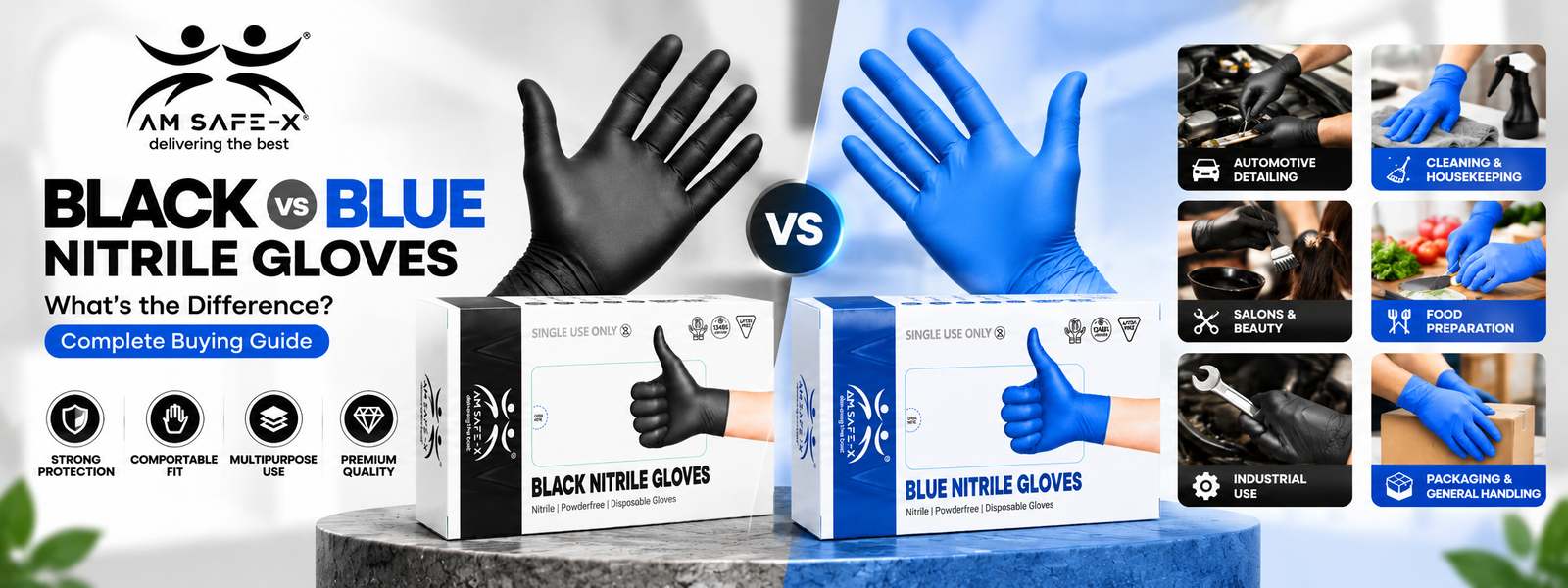
Black vs blue nitrile gloves: which one should you choose? If you’re shopping for disposable nitrile gloves in India, you’ve probably noticed that black and blue gloves are among the most common options available. While both are made from synthetic nitrile rubber, their colours can serve different practical purposes across automotive detailing, cleaning, salons, food preparation, packaging and general industrial handling.
But are black nitrile gloves stronger than blue ones? Does one colour offer better grip? Are blue gloves more suitable for food preparation? And which option gives you better value for money?
The short answer is that black and blue nitrile gloves are not inherently different in strength or protection simply because of their colour. Their performance depends on material formulation, thickness, texture, manufacturing quality and intended use.
However, colour can influence visibility, workplace identification, appearance and the ease of noticing certain stains or contaminants.
In this comprehensive guide, AM SAFE-X explains the differences between black and blue nitrile gloves, their advantages, common applications, buying considerations and how to choose the right option for your requirements.
Quick Answer: Black vs Blue Nitrile Gloves
Both black and blue nitrile gloves are made from synthetic nitrile rubber and can offer similar flexibility, comfort and handling performance when manufactured to comparable specifications.
The main practical difference is how their colours work in different environments.
Black nitrile gloves: Often preferred for automotive detailing, salons, grooming, workshops and tasks where a professional dark appearance is desirable.
Blue nitrile gloves: Often preferred for general cleaning, packaging, colour-coded workplaces and selected food-handling environments where visual contrast is useful.
Strength and durability: Depend on glove thickness, formulation and testing rather than colour alone.
Grip: Depends primarily on glove texture, fit and surface conditions.
Price: Depends on the individual product, pack quantity and specifications rather than colour alone.
Our recommendation: Choose black nitrile gloves if you prefer a professional appearance for suitable detailing, salon or routine handling tasks. Choose blue nitrile gloves when visibility and workplace colour identification are priorities.
Explore the AM SAFE-X nitrile gloves collection to compare available options.
1. What Are Nitrile Gloves?
Nitrile gloves are disposable gloves manufactured from a synthetic rubber material commonly known as nitrile butadiene rubber (NBR).
Unlike natural rubber latex gloves, nitrile gloves do not use natural rubber latex as their base material.
They are popular for many general-purpose applications because they can offer a practical combination of flexibility, grip, puncture resistance and comfort.
Key Features of Nitrile Gloves
Synthetic rubber construction
Nitrile gloves are manufactured using synthetic materials rather than natural rubber latex.
Powder-free options
Many nitrile gloves are available without added donning powder, making them useful for applications where powder residue is undesirable.
Comfortable fit
Properly sized nitrile gloves can conform to the hands and allow comfortable finger movement.
Puncture resistance
Nitrile gloves often offer better puncture resistance than many disposable vinyl alternatives, although performance varies by product.
Resistance to selected substances
Certain nitrile formulations can resist oils, greases and specific chemicals. However, compatibility must be verified for the actual substance and exposure conditions.
Multiple colour options
Nitrile gloves are manufactured in black, blue and several other colours to meet different workplace preferences and requirements.
Does Colour Change the Nitrile Material?
Not necessarily.
Black and blue nitrile gloves generally use the same base polymer category. Pigments are incorporated during manufacturing to create different colours.
However, two differently coloured products may also use different formulations, thicknesses or manufacturing processes.
Therefore, colour alone cannot establish whether two gloves offer equivalent performance.
2. Black vs Blue Nitrile Gloves: Complete Comparison Table
Understanding the differences becomes easier when both options are compared side by side.
| Feature | Black Nitrile Gloves | Blue Nitrile Gloves |
|---|---|---|
| Base material | Synthetic nitrile rubber | Synthetic nitrile rubber |
| Colour | Black | Blue |
| Appearance | Dark, professional look | Bright, highly recognizable look |
| Puncture resistance | Depends on specifications | Depends on specifications |
| Thickness | Varies by product | Varies by product |
| Grip | Depends on texture and fit | Depends on texture and fit |
| Flexibility | Depends on formulation | Depends on formulation |
| Grease visibility | Can conceal dark grease | Dark grease may be more noticeable |
| Visual contrast | Useful against light surfaces | Useful against many food and work surfaces |
| Common applications | Automotive detailing, salons, workshops | Cleaning, packaging, colour-coded operations |
| Powder-free availability | Available | Available |
| Latex-free options | Available | Available |
| Price | Product-dependent | Product-dependent |
| Overall performance | Specification-dependent | Specification-dependent |
Which Is Better Overall?
Neither black nor blue nitrile gloves are automatically superior.
For example, a well-manufactured blue nitrile glove may outperform a poorly manufactured black glove, and the reverse may also be true.
The right choice depends on the task, product specifications and working environment.
3. What Are Black Nitrile Gloves?
Black nitrile gloves are disposable synthetic rubber gloves manufactured with a black pigment.
They are particularly popular in industries where workers prefer a dark, professional appearance or frequently handle materials that leave visible stains.
Why Do People Prefer Black Nitrile Gloves?
1. Professional appearance
Black gloves can create a consistent, polished appearance in customer-facing businesses such as salons, grooming studios and automotive detailing services.
2. Dark colour conceals certain stains
Grease, oil residue, hair colour and ink may be less noticeable on black gloves than on lighter-coloured alternatives.
However, this can also make contamination more difficult to identify.
3. Suitable for many routine handling tasks
Depending on the product’s specifications, black nitrile gloves may be useful for selected cleaning, detailing, packaging and general handling applications.
4. Convenient disposable format
Single-use gloves are easy to replace between tasks when appropriate workplace procedures are followed.
5. Available in different sizes and thicknesses
Black nitrile gloves are manufactured in various specifications, allowing buyers to compare fit and performance.
Where Are Black Nitrile Gloves Commonly Used?
Black nitrile gloves are frequently selected for:
Car detailing and automotive cleaning
Barber shops and grooming studios
Hair salons
General workshop handling
Cleaning and housekeeping
Packaging operations
Routine maintenance
Beauty product handling
Actual suitability depends on the specific glove and the materials involved.
AM SAFE-X Black Nitrile Gloves
AM SAFE-X offers black, powder-free, latex-free disposable nitrile gloves in a convenient pack of 100.
Buyers can explore the available size options, current pricing and product details through the official website.
Shop AM SAFE-X Black Nitrile Gloves – Pack of 100
4. What Are Blue Nitrile Gloves?
Blue nitrile gloves are disposable synthetic rubber gloves manufactured with a blue pigment.
They are commonly selected for workplaces where visual contrast, easy identification and colour-coded operating procedures are useful.
Why Are Blue Nitrile Gloves Popular?
1. High visibility
Blue gloves can contrast clearly with many common work surfaces and materials.
This may make certain stains, glove fragments or visible damage easier to notice, depending on the surrounding environment.
2. Workplace colour coding
Some businesses assign different glove colours to separate departments or tasks.
For example, one colour may be designated for cleaning and another for packaging.
3. Familiar appearance
Blue nitrile gloves are widely recognized as disposable gloves and are frequently selected for routine professional use.
4. Convenient for general handling
Properly selected blue nitrile gloves can be useful for packaging, cleaning and other suitable low-risk activities.
5. Multiple specifications
Blue nitrile gloves are available in various thicknesses, textures, sizes and formulations.
Where Are Blue Nitrile Gloves Commonly Used?
Common applications include:
General housekeeping
Packaging and sorting
Food-handling environments where the glove is verified for food contact
Cleaning operations
Workplace colour-coding systems
General-purpose handling
Light maintenance
AM SAFE-X Blue Nitrile Gloves
AM SAFE-X also offers blue disposable nitrile gloves in packs of 100.
Buyers can compare the blue and black options through the official nitrile glove category.
Explore AM SAFE-X Blue Nitrile Gloves
5. Are Black Nitrile Gloves Stronger Than Blue Nitrile Gloves?
This is one of the most common questions people ask when comparing nitrile glove colours.
The answer is no: black nitrile gloves are not automatically stronger than blue nitrile gloves.
Glove strength depends on several technical factors.
A. Glove Thickness
Thickness can influence physical durability, but it does not determine performance on its own.
Glove thickness is commonly measured in mils.
One mil equals approximately 0.0254 millimetres.
| Thickness | Approximate millimetres | General description |
|---|---|---|
| 3 mil | 0.076 mm | Thin disposable glove |
| 4 mil | 0.102 mm | General-purpose thickness category |
| 5 mil | 0.127 mm | More substantial disposable glove |
| 6 mil | 0.152 mm | Thicker disposable option |
| 8 mil | 0.203 mm | Heavy-duty disposable category |
These values describe thickness, not guaranteed durability or protection.
A thicker blue nitrile glove may be more substantial than a thinner black glove.
Likewise, a thicker black glove may offer different handling characteristics than a thinner blue option.
B. Material Formulation
Nitrile gloves can use different polymer formulations and manufacturing processes.
These differences may influence flexibility, tensile strength, elongation and resistance to tearing.
C. Manufacturing Quality
Consistent manufacturing and quality control can affect glove reliability.
Two products with similar thicknesses may still perform differently.
D. Intended Application
A glove suitable for light packaging may not be appropriate for automotive chemical handling.
Always compare the specific product’s documented performance.
Final Verdict on Strength
Choose nitrile gloves by verified specifications, not by colour.
If black and blue gloves are manufactured to comparable tested specifications, their performance may be similar. But this should not be assumed without supporting product information.
6. Black vs Blue Nitrile Gloves: Which Has Better Grip?
Grip is another important consideration, particularly for automotive detailing, cleaning and precision handling.
However, colour does not determine grip.
What Actually Affects Grip?
Surface texture
Some nitrile gloves have textured fingertips, textured palms or other grip-enhancing patterns.
Correct sizing
A glove that fits securely can make it easier to handle objects.
Material flexibility
The glove formulation can influence how comfortably the material moves with the hand.
Working conditions
Wet, oily or slippery surfaces can change how a glove performs.
Are Black Gloves Better for Automotive Grip?
Not automatically.
Some black nitrile gloves are marketed for automotive use, but the actual grip depends on their texture, fit and performance characteristics.
A textured blue glove may provide better grip than a smooth black glove under certain conditions.
What Should Buyers Look For?
Before purchasing gloves for handling tools or equipment, check:
Fingertip texture
Palm texture
Glove fit
Material flexibility
Manufacturer specifications
Suitability for the working conditions
7. Black vs Blue Nitrile Gloves for Automotive Detailing
Automotive detailing is one of the most common applications associated with black nitrile gloves.
Detailing professionals frequently handle dust, dirt, oils, cleaning solutions, polishes and other automotive care products.
Why Black Nitrile Gloves Are Popular for Car Detailing
Professional appearance
Black gloves can complement the presentation of a professional detailing studio.
Less noticeable dark stains
Grease and dark residue may be less visible against black glove material.
Comfortable handling
When correctly sized, nitrile gloves can allow the finger movement required for many detailing tasks.
Disposable convenience
Gloves can be changed between appropriate tasks to reduce the transfer of unwanted residue.
Can Blue Nitrile Gloves Be Used for Car Detailing?
Yes, provided the particular product is suitable for the intended task.
Blue nitrile gloves can be useful when workers want dark grease or other contamination to be more visible.
Which Should You Choose?
For appearance-focused detailing operations, black nitrile gloves may be the preferred option.
For operations where visible contamination is a priority, blue gloves may offer an advantage.
Important: Neither colour guarantees resistance to automotive solvents, fuels, degreasers or other chemicals. Check product-specific chemical compatibility before use.
8. Black vs Blue Nitrile Gloves for Cleaning and Housekeeping
Cleaning businesses often need disposable gloves for routine handling and selected cleaning activities.
Both black and blue nitrile gloves may be suitable for certain tasks, depending on the product and cleaning materials.
Benefits of Black Nitrile Gloves for Cleaning
Professional dark appearance
May conceal certain visible stains
Convenient for selected routine handling tasks
Available in powder-free options
Benefits of Blue Nitrile Gloves for Cleaning
High visual contrast
Useful for workplace colour-coding systems
Can make certain dark stains more noticeable
Available in multiple sizes and specifications
Which Is Better for Housekeeping?
For general cleaning, choose based on fit, comfort, task requirements and compatibility with cleaning products.
For businesses that use colour coding, blue and black gloves can be assigned to different activities to support internal procedures.
However, colour coding is only useful when employees follow the system consistently.
For concentrated cleaning chemicals or extended chemical exposure, reusable chemical-resistant gloves may be more appropriate than thin disposable gloves.
9. Black vs Blue Nitrile Gloves for Salons and Beauty Professionals
Salons, barber shops and grooming businesses frequently use disposable gloves during selected beauty and cleaning tasks.
Why Black Gloves Are Popular in Salons
Black gloves can create a modern, professional appearance.
They may also make dark hair dyes and other stains less noticeable.
For customer-facing businesses, this appearance can be an important preference.
Can Blue Nitrile Gloves Be Used in Salons?
Yes.
Blue nitrile gloves may be selected for routine handling where the product is appropriate.
They can also make some product residues more visible, helping workers identify when gloves need changing.
What Matters More Than Colour?
For salon applications, the most important factors include:
Comfortable fit
Suitable finger movement
Powder-free construction where preferred
Appropriate grip
Compatibility with hair dyes and other products
Correct replacement practices
Which Colour Should Salon Owners Choose?
Black nitrile gloves are a popular aesthetic choice, while blue nitrile gloves can be a practical alternative where visibility is preferred.
The best option depends on the business’s working procedures and the glove’s verified suitability.
10. Black vs Blue Nitrile Gloves for Food Handling
Colour can be particularly relevant in food-handling environments.
Blue is commonly used in colour-coded food production systems because it contrasts with many food ingredients.
However, blue colour does not automatically mean a glove is approved for food contact.
Why Do Some Food Businesses Prefer Blue Gloves?
Blue can provide a visible contrast against many food materials.
This can help employees notice certain glove fragments or identify gloves assigned to particular work areas.
Can Black Nitrile Gloves Be Used for Food Preparation?
Potentially, but only when the specific product has documented suitability for the intended food-contact application.
Black nitrile gloves should not be considered food-contact suitable merely because they are nitrile or powder-free.
Are Blue Gloves Automatically Food-Safe?
No.
Food-contact suitability depends on the product’s formulation, intended use and applicable compliance documentation.
Which Colour Should Food Businesses Choose?
If a food business uses colour-coded procedures, blue may be preferred for visibility.
However, the primary requirement is selecting a glove that is verified as appropriate for the intended food-contact application.
Employees must also follow proper handwashing and glove-changing procedures.
11. Black vs Blue Nitrile Gloves for Packaging and General Handling
Packaging operations often involve repetitive tasks, sorting, labeling, product handling and movement of materials.
Both black and blue nitrile gloves can be used for suitable routine handling activities.
Black Nitrile Gloves for Packaging
Black gloves may be selected where appearance or workplace uniformity is important.
Blue Nitrile Gloves for Packaging
Blue gloves may be useful for teams that want a distinct colour for specific departments or activities.
What Should Packaging Businesses Prioritize?
Comfortable sizing
Ease of movement
Suitable durability
Appropriate grip
Reliable packaging quantity
Reasonable cost per glove
For many packaging tasks, fit and handling performance are more important than colour.
12. Are Black or Blue Nitrile Gloves More Chemical Resistant?
Neither black nor blue nitrile gloves are automatically more chemically resistant.
Chemical resistance depends on the glove formulation, thickness, construction and the substance involved.
Factors That Affect Chemical Resistance
Chemical type
Different chemicals interact differently with nitrile rubber.
Chemical concentration
A concentrated substance may behave differently from a diluted solution.
Contact duration
Brief incidental contact and prolonged exposure are not equivalent.
Temperature
Higher temperatures can affect glove performance.
Glove formulation
Different nitrile products may have different resistance characteristics.
Physical condition
Torn or degraded gloves should not be relied upon.
How Should Buyers Choose?
For tasks involving chemical exposure, consult the chemical’s Safety Data Sheet and the glove manufacturer’s chemical compatibility information.
For hazardous chemicals or prolonged exposure, seek task-specific protective equipment guidance.
Important: Disposable nitrile gloves should never be assumed to provide universal chemical protection, regardless of their colour.
13. Are Black Nitrile Gloves More Expensive Than Blue?
Not necessarily.
The price of nitrile gloves depends on:
Material formulation
Thickness
Manufacturing quality
Pack quantity
Brand
Supplier
Purchase volume
Product specifications
AM SAFE-X Black and Blue Nitrile Gloves Price Comparison
At the time of preparing this guide, the AM SAFE-X online nitrile collection lists:
| Product | Pack size | Listed price | Price per glove |
|---|---|---|---|
| AM SAFE-X Black Nitrile Gloves | 100 | ₹449 | ₹4.49 |
| AM SAFE-X Blue Nitrile Gloves | 100 | ₹449 | ₹4.49 |
Prices are indicative and may change. Check the product listing for the current price and available variants.
Which Offers Better Value?
When two glove products are similarly priced, consider their actual specifications, intended application, fit and handling performance.
A glove that suits the task properly may provide better value than one selected only because of its colour.
14. How to Choose the Right Nitrile Gloves in India
Before purchasing black or blue nitrile gloves, follow this buying checklist.
Step 1: Identify Your Application
Determine whether the gloves are intended for detailing, cleaning, salon work, packaging or another routine task.
Step 2: Choose Your Preferred Colour
Black may be preferred for appearance, while blue may be preferred for visibility or workplace identification.
Step 3: Check the Material
Confirm that the product is manufactured from nitrile.
Step 4: Compare Thickness
Review the manufacturer’s actual thickness specifications.
Step 5: Select the Correct Size
Measure your hand and follow the product-specific size chart.
Step 6: Review Grip and Texture
Check whether the glove has smooth or textured fingertips and whether that suits your task.
Step 7: Check Product Suitability
Review the manufacturer’s intended-use instructions and relevant technical information.
Step 8: Compare Price per Glove
Divide the pack price by the number of gloves.
Step 9: Review Packaging and Supplier Information
Look for clear product descriptions, pack quantities and available product documentation.
Step 10: Purchase From a Reliable Seller
Choose a seller offering accurate product information and clear purchasing terms.
15. Why Choose AM SAFE-X Nitrile Gloves?
AM SAFE-X offers disposable nitrile gloves in both black and blue options for buyers looking for general-purpose hand protection products.
The AM SAFE-X nitrile collection includes packs of 100 gloves, allowing customers to compare available colour and size options.
AM SAFE-X Black Nitrile Gloves
A black, powder-free, latex-free disposable nitrile glove option for buyers who prefer a professional dark appearance.
Buy AM SAFE-X Black Nitrile Gloves
AM SAFE-X Blue Nitrile Gloves
A blue nitrile glove option for buyers who prefer greater visual contrast or want to introduce colour identification into suitable routine work.
Explore AM SAFE-X Blue Nitrile Gloves
Why Compare Both Options?
The right colour depends on your working environment, appearance preferences and handling requirements.
Neither colour should be treated as a substitute for checking the product’s actual specifications.
16. Common Mistakes When Choosing Black or Blue Nitrile Gloves
Mistake 1: Assuming Black Gloves Are Always Stronger
Black colour does not guarantee additional strength.
Mistake 2: Assuming Blue Gloves Are Always Suitable for Food Contact
Food-contact suitability must be verified for the specific product.
Mistake 3: Choosing Gloves Based Only on Appearance
Colour matters for presentation and visibility, but fit and suitability remain essential.
Mistake 4: Ignoring Thickness
Different products can have significantly different thicknesses.
Mistake 5: Buying the Wrong Size
Poor fit can reduce comfort and control.
Mistake 6: Assuming All Nitrile Gloves Resist Every Chemical
Chemical compatibility varies considerably.
Mistake 7: Reusing Disposable Gloves
Single-use gloves should be discarded after use according to the manufacturer’s instructions.
Mistake 8: Comparing Box Prices Without Checking Quantity
Always calculate the cost per glove.
17. Frequently Asked Questions: Black vs Blue Nitrile Gloves
Q1. What is the main difference between black and blue nitrile gloves?
The main visible difference is colour. Black gloves are often preferred for professional appearance and concealing certain stains, while blue gloves may provide better visual contrast in selected environments. Actual performance depends on product specifications.
Q2. Are black nitrile gloves stronger than blue nitrile gloves?
Not automatically. Strength depends on thickness, formulation and manufacturing quality rather than colour alone.
Q3. Are blue nitrile gloves better for cleaning?
Blue gloves may be useful for colour-coded cleaning operations, but the best option depends on the task and glove specifications.
Q4. Why do car detailers prefer black nitrile gloves?
Many car detailers prefer black gloves because they create a professional appearance and make certain grease stains less noticeable.
Q5. Can blue nitrile gloves be used for automotive detailing?
Yes, when the specific glove is suitable for the intended detailing task and any substances involved.
Q6. Are black nitrile gloves more durable?
Not necessarily. Durability varies by product formulation, thickness and quality.
Q7. Which nitrile glove colour offers better grip?
Neither colour automatically offers better grip. Grip depends on texture, fit and working conditions.
Q8. Are black and blue nitrile gloves latex-free?
Nitrile gloves are manufactured from synthetic nitrile rubber rather than natural rubber latex. Check the product label for the exact formulation.
Q9. Are black and blue nitrile gloves powder-free?
Both colours are available in powder-free versions. Confirm the specification for the product being purchased.
Q10. Which nitrile gloves are best for salons?
Black nitrile gloves are often preferred for their professional appearance, but suitability depends on comfort, fit and compatibility with salon products.
Q11. Are blue nitrile gloves suitable for food handling?
Only when the specific product has verified suitability for the intended food-contact application. Colour alone is not sufficient.
Q12. Are black nitrile gloves suitable for food handling?
The same requirement applies: the specific glove must be documented as suitable for the intended food-contact application.
Q13. Do black nitrile gloves cost more than blue nitrile gloves?
Not necessarily. Pricing depends on the brand, formulation, thickness, pack quantity and supplier.
Q14. How many gloves come in an AM SAFE-X pack?
AM SAFE-X lists both black and blue nitrile gloves in packs of 100.
Q15. Which nitrile gloves should I buy for everyday use?
Choose gloves that fit comfortably and are appropriate for your intended routine handling tasks. Colour can be selected according to preference.
Q16. Are black nitrile gloves suitable for workshop use?
They may be suitable for selected routine workshop tasks, but chemical exposure, sharp objects and machinery hazards require separate consideration.
Q17. Can nitrile gloves be reused?
Disposable nitrile gloves are generally designed for single use and should not be reused.
Q18. Which is better: black or blue nitrile gloves?
Neither colour is universally better. Black may be preferred for appearance, while blue may be preferred for visual contrast. Product quality and suitability matter more than colour.
Q19. Where can I buy black nitrile gloves online in India?
You can explore AM SAFE-X Black Nitrile Gloves – Pack of 100 on the official AM SAFE-X website.
Q20. Where can I buy blue nitrile gloves in India?
Visit the AM SAFE-X nitrile gloves collection to explore the available blue nitrile gloves.
18. Final Verdict: Black vs Blue Nitrile Gloves — Which Should You Buy?
Choosing between black and blue nitrile gloves is easier when you focus on your actual requirements.
Choose black nitrile gloves if:
You prefer a professional dark appearance.
You work in suitable automotive detailing or salon environments.
You want gloves that make certain dark stains less noticeable.
Your business prefers a consistent black glove appearance.
Choose blue nitrile gloves if:
You prefer a bright, recognizable glove colour.
Your workplace uses colour-coded procedures.
You want certain stains or glove fragments to be more visible.
You need gloves for suitable routine cleaning or packaging tasks.
Our Final Recommendation
For most buyers, the best nitrile glove is not determined by colour.
The most important factors are material quality, fit, thickness, grip, product suitability and value for money.
Both black and blue nitrile gloves can be practical options for general-purpose applications when the specific product is appropriate for the task.
AM SAFE-X offers both colours, making it easier for buyers to select an option that matches their preferences and working environment.
Shop AM SAFE-X Black Nitrile Gloves – Pack of 100
Explore AM SAFE-X Blue Nitrile Gloves
AM SAFE-X — Delivering the Best.
Further Reading
For more information about choosing gloves for different tasks, consult:

